Visit The James Senior Living website ↗
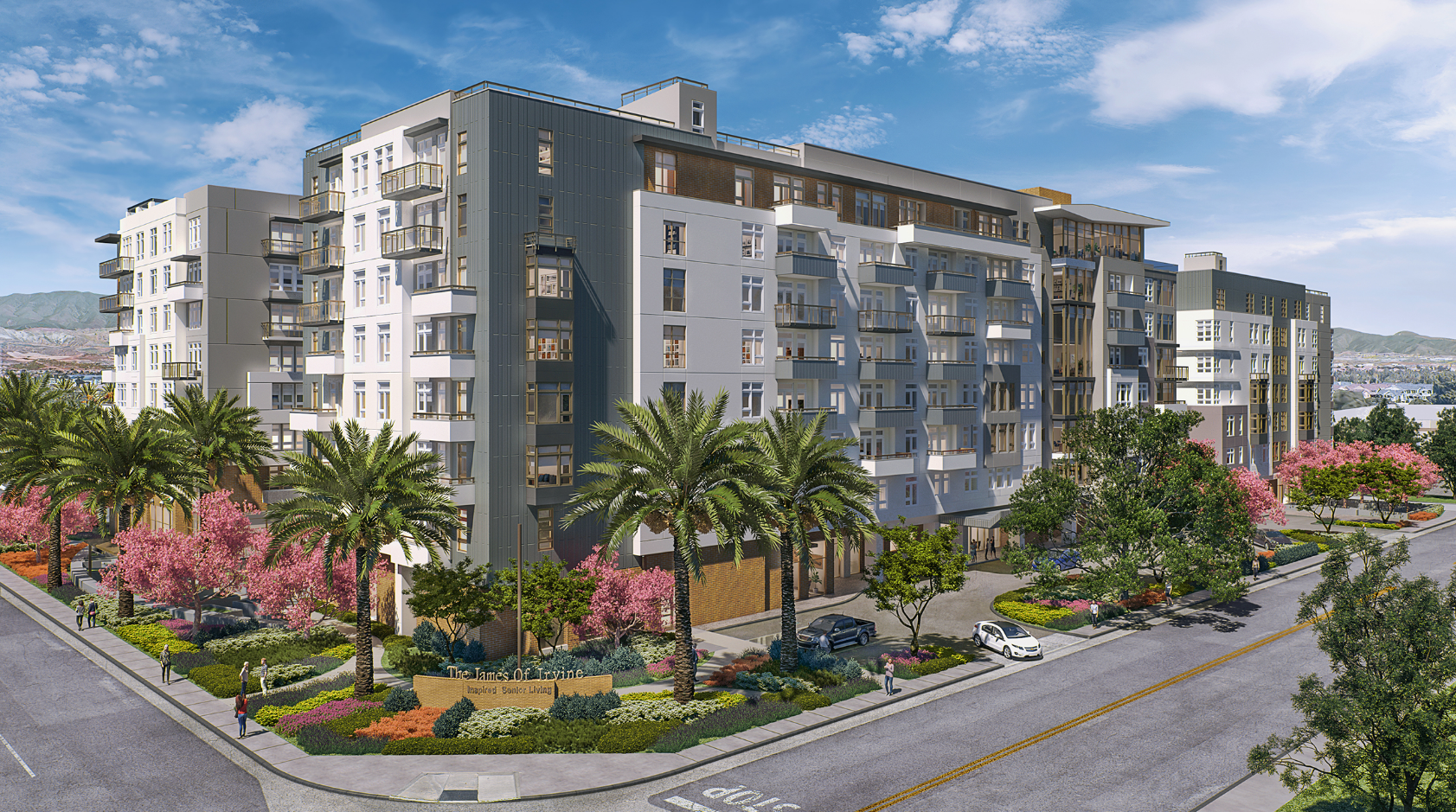
A 350-unit luxury senior living community is under construction in Irvine, financed with $473 million of municipal bonds and no equity ownership. It is not an affordable housing deal. There are no income-restricted units. Independent living rents start above $9,000 a month.
I spent some time in the Official Statement and the continuing disclosure filings on EMMA, because the structure is one that more developers are going to encounter — and a few will try to replicate. Here is how it works and where the risk sits.
The basic move
The James sits at Tustin Legacy, at 1001 Gates Avenue: 210 independent living units, 110 assisted living and 30 memory care, in two towers over subterranean parking. Harbert South Bay Partners is the developer. Momentum Senior Living will operate it.
But neither of them owns it. The owner is P3 Irvine SL Holdings, LLC, a single-purpose entity whose sole member is P3 Foundation, Inc., a 501(c)(3). That nonprofit ownership is the whole mechanism. It makes the project eligible for qualified 501(c)(3) bonds, issued through the California Public Finance Authority as conduit. The City of Irvine held the required TEFRA hearing and has no financial or legal obligation for the debt.
Two consequences follow, and they are the reason this structure exists:
No volume cap. Multifamily private activity bonds under Section 142(d) require an allocation from CDLAC, which is heavily oversubscribed in California. Qualified 501(c)(3) bonds require no allocation at all.
No income set-asides. Section 142(d) bonds carry a 20/50 or 40/60 affordability requirement. 501(c)(3) bonds carry none. Federal charitable qualification for elderly housing runs through Revenue Rulings 72-124 and 79-18 — operating at the lowest feasible cost, meeting residents' housing, health care and financial security needs, and retaining residents who later cannot pay — rather than through restricted units.
Because private business use in a 501(c)(3) bond financing is capped at 5%, the for-profit parties cannot hold ownership equity. They participate by contract instead: a development agreement, a property management agreement, an asset management agreement, and as purchasers of subordinate bonds.
The capital stack
| Series | Amount | Terms |
|---|---|---|
| 2024A senior, tax-exempt | $442.10M | Coupons 5.70%–6.50%; yields 5.70%–6.55%; terms 2034–2059 |
| 2024B senior, taxable | $12.93M | 8.25%, due 2033 |
| 2024C subordinate | $10.00M | Capital appreciation bond accreting at 8.0%, final 2034 |
| 2024D subordinate | $8.00M | Capital appreciation bond accreting at 8.0%, final 2039 |
The bonds are unrated and secured by a gross revenue pledge and a mortgage. The senior offering drew 27 institutional investors and was reported by the underwriter as nearly two times oversubscribed.
Note the subordinate bonds. They accrete rather than pay currently, so the $18 million of par grows to roughly $41.6 million at maturity. Total par debt is about $1.35 million per unit; principal ultimately repayable is closer to $1.42 million per unit.
Why the rate is not the point
The interest savings from tax exemption are real but smaller than people assume. This deal prices both sides of the question: taxable bonds cleared at 8.25% while tax-exempt senior bonds cleared at 5.70%–6.55%. The tenors differ, so that spread is not purely the exemption, but the direction is obvious.
The bigger advantage is leverage and term. Total project cost is about $336.7 million, roughly $962,000 per unit. Total bond debt is about $1.35 million per unit. The difference goes to roughly $90 million of capitalized interest, a $34.7 million debt service reserve, $17.5 million of working capital and $13 million of issuance costs. About 28% of the financing buys time and cushion rather than building.
Compare that to the conventional alternative: a floating-rate construction loan at 55–65% of cost, a completion guaranty, a refinancing within three years, and 35–45% equity priced in the high teens. Here the entire stack is 35-year fixed-rate non-recourse debt with interest funded through lease-up. The blended cost of capital falls mainly because expensive equity is replaced with bonds, not because the debt itself is cheap.
The underwriter's own case study is candid about the reason: the sponsor could not raise sufficient conventional debt and equity for a project this size, and the nonprofit structure solved it.
What the feasibility study assumes
CliftonLarsonAllen examined management's forecast in October 2024. The stabilized year, 2030, shows $72.1 million of revenue, $42.0 million available for debt service against $30.65 million of senior debt service — 1.37x coverage — and 105 days cash on hand. Breakeven occupancy is about 77%.
Those numbers depend on weighted average monthly fees of roughly $15,900 for independent living in 2027, rising to $17,600 by 2030, and on a 30-month fill-up at 15 then 10 move-ins per month. Both are testable assumptions, and both are the right place to focus.
The rent history is the most interesting number
The same site had a different plan in 2017. The applicant's use determination package filed with the City of Irvine listed projected rents. Comparing those to the base fee schedule in the 2024 bond documents:
| Unit type | 2017 | 2024 | Change | Annual rate |
|---|---|---|---|---|
| IL one-bedroom | $6,700 | $9,064–$12,397 | +60% | 6.9% |
| IL two-bedroom | $8,000–$9,000 | $12,612–$22,000 | +104% | 10.6% |
| AL studio | $5,650 | $7,117–$10,076 | +52% | 6.1% |
| Memory care studio | $7,000–$7,450 | $14,500 | +101% | 10.3% |
The programs differ — 375 units in 2017 versus 350 as financed, different unit sizes, and the 2017 rates included three meals a day where the financed program lists a limited meal plan for independent living. So treat it as approximate.
Even so, the pattern is worth sitting with. One-bedrooms and assisted living studios grew at roughly market rates. Two-bedrooms and memory care doubled. The repricing concentrated in the larger units and the higher-acuity product, which is exactly where the forecast's weighted averages carry the most weight.
Where the risk actually sits
The developer and manager earn fees whether or not the project stabilizes. Bondholders — unrated, fixed-rate, 35-year — carry lease-up and rent risk, cushioned by funded interest, the reserve funds and a $12 million liquidity facility from the developer. The developer also holds $8 million of subordinate bonds, so there is real first-loss alignment, but it sits under $455 million of senior debt.
Startup senior living has historically been among the more default-prone corners of the municipal market. That is why these bonds priced in the 6% range despite being tax-exempt, and why the deal is structured with a seven-year call at 103: stabilize, then refinance.
As of the July 2026 disclosure, construction was about 56% complete with substantial completion projected for May 2027. No deposit or reservation data has appeared in the filings.
What this means if you develop
This template works where rents support financing close to 100% of cost. That is a short list of submarkets, and most senior living sites in the Inland Empire or the Coachella Valley would not pencil under it. It also requires a nonprofit partner willing to own the asset, a capital markets team that can place unrated high-yield paper, and a feasibility study that institutional buyers will accept.
But the underlying logic travels further than senior living. When equity is expensive and construction debt is constrained, the question becomes which tax-exempt tool fits the asset and who has to own it for that tool to work. That is worth knowing before you need it.
Everything above comes from public documents: the Official Statement dated November 14, 2024, including the feasibility study at Appendix B; continuing disclosure filings posted on MSRB EMMA; California Public Finance Authority board materials; and the City of Irvine's 2017 use determination file. The full analysis, including a capital structure breakdown, fee disclosures, site history and an illustrative stress test, is available as a PDF.
Download the full overview (PDF) ↗
Independent analysis prepared from public records by DL Smith Company, LLC. I have no relationship with any party to this transaction and was not compensated by any of them. This is informational only — not investment, legal or tax advice, and not a recommendation to buy or sell any security.