A back-of-the-napkin look at The Beaudry's economics
The headline vs. the story
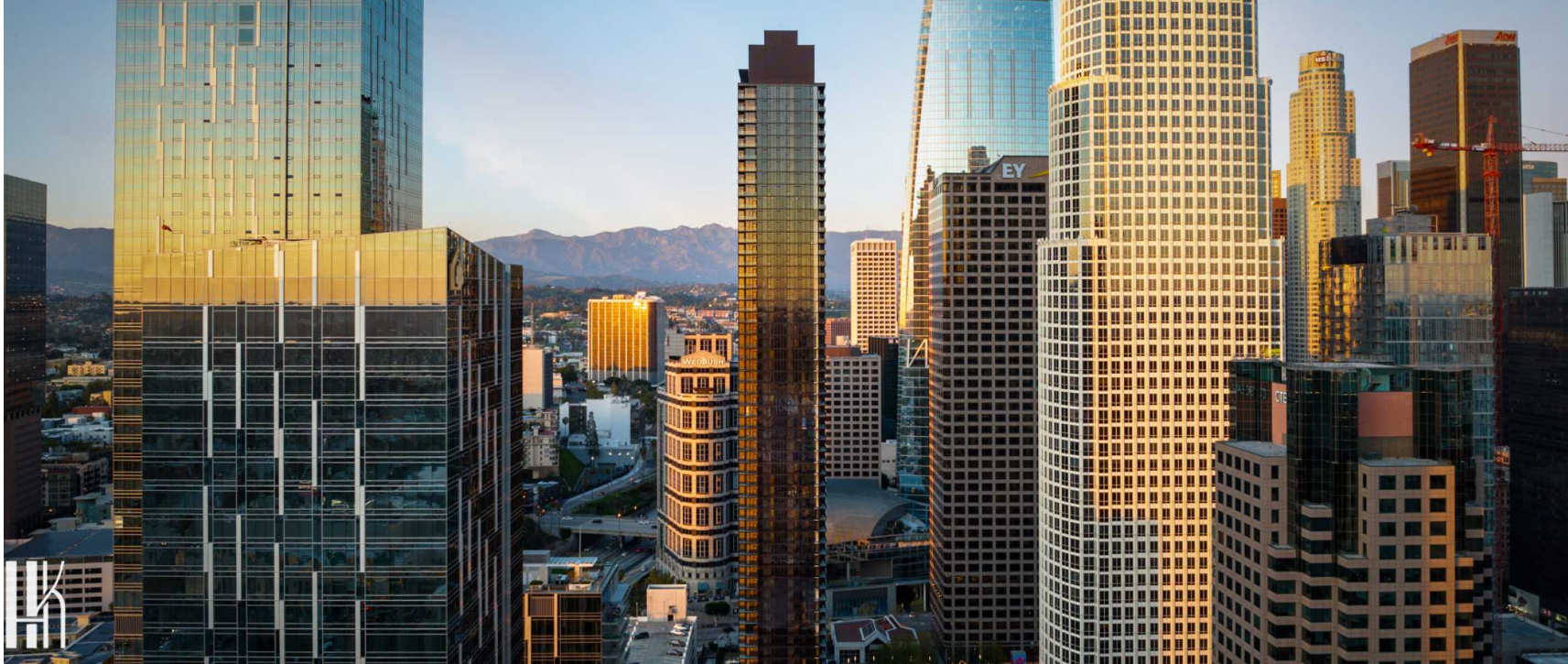
Brookfield is handing back The Beaudry, the 64-story, 785-unit apartment tower in Downtown Los Angeles, less than four years after opening it. Rather than refinance the property's roughly $360 million loan, Brookfield is walking away, and the lender, Apollo-owned Bridge Investment Group, is reportedly marketing the loan for sale.
The easy takeaway is that Downtown LA apartments are failing.
The facts suggest something different.
The building is reportedly about 95% occupied and asking rents are roughly $4,200 per month. In other words, this is not an empty tower struggling to attract tenants. By most accounts, the property leases well.
What appears to have broken wasn't demand. It was the relationship between development cost, operating income, debt, and the amount of new equity required to refinance the existing loan.
Two details matter more than the headline.
First, The Beaudry reportedly sits in the same Brookfield fund as several nearby office assets that have already been handed back to lenders, and that fund is nearing the end of its life. When a fund is approaching liquidation, investors generally have little interest in writing another large equity check into an asset that may need to be sold in the near future anyway.
Second, refinancing appears to have required a significant paydown. Reporting indicates that replacing the existing loan would have required tens of millions of dollars of new capital, while market participants have suggested that higher debt costs effectively wiped out the property's remaining equity.
The loan maturity forced a decision. The economics largely determined which decision made the most sense.
The model below isn't intended to estimate Brookfield's actual returns. It's simply a framework for understanding why handing back a nearly full apartment building can still be the rational financial outcome.
What the building probably earns
The unit count, rents, occupancy, loan balance, and development cost are drawn from public reporting. Everything else is my estimate.
| Line item | Estimate |
|---|---|
| Gross potential rent (785 units × $4,200 × 12) | $39.6M |
| Vacancy (5%) | –$2.0M |
| Concessions (about 6 weeks free on turnover, ~6%) | –$2.4M |
| Other income (parking, fees) | +$2.0M |
| Effective gross income | ~$37.2M |
| Property tax (~1.2% of a ~$600M assessment) | –$7.2M |
| Operating expenses (~$11.5K/unit, high-rise) | –$9.0M |
| Replacement reserves | –$0.3M |
| Net operating income (NOI) | ~$21M |
That produces a yield on cost of roughly 3.5%.
For a high-rise apartment development of this scale, that's likely well below where the project was originally underwritten. A 5.5% yield on cost would require approximately $33 million of NOI, suggesting the building may be generating only about two-thirds of the income necessary to support its original economics.
Whether the shortfall came from rents, expenses, taxes, or some combination of the three, the outcome is the same: the investment economics are significantly tighter than the development pro forma likely assumed.
Property taxes deserve special attention here. On a newly built, high-basis tower, taxes can consume a surprising amount of income. Unlike many operating expenses, they don't fall meaningfully just because market conditions deteriorate.
The existing loan
Assume the current $360 million loan is floating at roughly 7% all-in.
That would imply annual interest expense of approximately $25 million against about $21 million of NOI.
Under that scenario, the property's debt service coverage ratio (DSCR) would be roughly 0.83x.
In other words, the building may not have been generating enough cash flow to fully support its existing debt even before the maturity date arrived.
That distinction matters.
This wasn't simply a refinancing problem caused by conservative lenders. It may also have been a cash flow problem.
How big a refinance the building supports
A lender underwriting a new loan would likely size proceeds using whichever constraint produces the lowest loan amount.
| Lender test | Maximum loan |
|---|---|
| 1.25× DSCR, 6.0% rate, 30-year amortization | ~$233M |
| 8% debt yield | ~$262M |
| 60–65% of ~$400M value | ~$240–260M |
The DSCR test appears to be the controlling factor, suggesting new debt capacity of roughly $233 million.
Against a $360 million existing balance, that implies a paydown of approximately $127 million.
Reporting described the required equity contribution as "tens of millions," which may indicate actual NOI was somewhat higher than my estimate. If NOI were closer to $24-25 million, the refinancing gap would shrink considerably.
Either way, the larger point remains unchanged: the refinancing likely required a substantial amount of new equity.
Brookfield’s three options
Assume a value of roughly $400 million.
That corresponds to a cap rate of about 5.25% on $21 million of NOI, which feels like a reasonable middle ground for discussion.
A. Pay down the loan and hold
Under this scenario, Brookfield contributes about $130 million of new capital, consisting of the approximately $127 million paydown plus refinancing costs.
The property is refinanced with about $233 million of new debt.
That leaves approximately $167 million of equity value in the asset.
However, the fund reportedly needs to monetize investments in the relatively near future.
Assuming a future sale around $400 million, roughly $22 million of Measure ULA tax and approximately $6 million of disposition costs reduce net proceeds.
That leaves about $139 million of sale proceeds to equity.
Put differently, investors commit approximately $130 million of new capital today to preserve roughly $139 million of future value.
The outcome is positive, but not dramatically so, particularly given execution risk and uncertainty around future cap rates.
B. Sell now
At a $400 million gross value:
- Less approximately $22 million Measure ULA tax
- Less approximately $6 million of transaction costs
- Less approximately $360 million loan payoff
Estimated remaining equity: roughly $12 million.
There is substantial sensitivity around this number, but the broad conclusion is that very little equity appears to remain after repayment of debt and exit costs.
C. Hand back the keys
Estimated equity recovery: $0.
No new capital is required.
The property stops consuming management attention and negative carry. Once the numbers become this close, the discussion shifts away from the property itself and toward capital allocation.
If selling today produces little or no recovery for equity, while refinancing requires a nine-figure capital contribution into an aging fund, the rationale for holding becomes difficult to justify.
At that point, surrendering the asset is not necessarily an admission that the building failed.
It may simply be the least expensive option available.
An important point often gets overlooked here: the size of the refinancing paydown changes how much cash investors must contribute, but it does not dramatically change the ultimate economics.
Every dollar used to pay down the loan effectively comes back as equity in the property.
The real question was likely whether investors wanted to contribute another $100+ million to preserve an outcome that remained highly dependent on future cap rates and sale conditions.
For a fund near the end of its life, that's a difficult case to make.
The underappreciated factor of Measure ULA
One part of this story deserves more attention: Los Angeles' Measure ULA transfer tax.
At a roughly $400 million sale price, ULA alone could add approximately $22 million of transaction costs.
That doesn't affect occupancy.
It doesn't affect rents.
It doesn't change operating performance.
What it does change is the owner's exit math.
Without ULA, a sale might have generated roughly $30 million of residual value rather than something much closer to break-even.
Viewed another way, a property's value does not have to fall below the loan balance for equity to disappear.
It only needs to fall below the loan balance plus whatever transaction costs are required to exit. In Los Angeles, those costs are unusually high.
That may also help explain why the lender appears interested in selling the note rather than taking title and marketing the real estate directly.
A note sale is not the same thing as a deed transfer.
Whether and how Measure ULA applies under various foreclosure or note-sale structures is ultimately a legal and tax question that I have not independently verified.
Who absorbs the loss
Brookfield’s fund
Potentially the vast majority of an estimated $240 million equity investment, plus any operating deficits and carrying costs incurred during ownership.
The lender
A roughly $360 million loan secured by an asset that may be worth approximately $400 million before accounting for disposition costs.
The eventual buyer
This may be where the opportunity lies.
If a note buyer acquires the debt at 80-90 cents on the dollar, the purchase price could land somewhere around $290-325 million.
That equates to approximately $370,000-$415,000 per unit for a three-year-old luxury tower that reportedly cost roughly $765,000 per unit to develop.
Where this math could be wrong
Real estate is highly sensitive to small changes in assumptions.
Several items could materially change the conclusions: If the assessed value is materially below $600 million, NOI could be $1-2 million higher. The reported $4,200 figure appears to be asking rent, not necessarily in-place rent. Actual rents could be lower, which would reduce NOI. The actual interest rate, extension rights, reserves, guarantees, and lender protections are not publicly available.
Any of those could affect the economics. This is probably the most important variable.
At a 5.0% cap rate, value approaches $420 million and equity outcomes improve.
At 5.75%, value falls toward $365 million and walking away becomes a much easier decision to understand.
What it means for development
The broader implication extends beyond a single tower.
If a newly built Downtown Los Angeles high-rise is worth roughly $400,000 per unit in today's market but costs $750,000-plus per unit to build, new high-rise apartment development simply does not pencil.
At least not today.
Capital tends to move where returns are achievable.
If high-rise multifamily cannot produce acceptable yields, investment dollars will migrate toward lower-cost product types, suburban markets, garden apartments, build-to-rent communities, and other opportunities where development spreads still exist.
For buyers with long investment horizons, however, the same conditions can create attractive opportunities.
Acquiring a stabilized Class A tower at little more than half of replacement cost is the type of trade that can produce compelling returns if capital markets eventually normalize.
The most important number in this story isn't Brookfield's basis or even the current value estimate.
It's the price at which the loan eventually trades.
That transaction may provide one of the clearest market-based indications of what investors are currently willing to pay for a recently built Los Angeles high-rise apartment tower.
If the note trades at a steep discount, the implications extend well beyond a single building.
It would be another signal that, at current construction costs and financing terms, new downtown apartment development remains economically challenging.
For that reason alone, The Beaudry is worth watching.
The story isn't whether the tower is leased.
It's what the market ultimately decides the tower is worth.
Disclosures
Estimates, not facts. Except for figures attributed to public reporting (unit count, opening date, approximate cost, loan amount, occupancy and asking rents), every number in this post is the author's own estimate or assumption, made for illustration. Actual operating results, loan terms, valuations and tax outcomes may differ materially.
No inside information. This analysis is based solely on publicly available news reports. The author has no affiliation with, and no non-public information from, Brookfield, Bridge Investment Group, Apollo, or any party to the transaction.
No position. Neither the author nor DL Smith Company, LLC holds any interest in The Beaudry, its loan, or the companies named, and none is acting for any party in this transaction.
Not advice. This post is for informational and educational purposes only. It is not investment, legal, tax or accounting advice, and it is not an offer or solicitation to buy or sell any security, loan or real property. Consult qualified professionals before making any decision.
Tax treatment not verified. Comments about Measure ULA are general. How the tax applies to any specific foreclosure, deed-in-lieu or note-sale structure should be confirmed with qualified tax and legal counsel.
License disclosure. Dustin Smith is a licensed California real estate broker, DRE #01850408. DL Smith Company, LLC provides development management and consulting services.
Opinions are the author's own and may change without notice.
Sources
Bisnow: Brookfield Gives Up DTLA's Beaudry Apartment Tower
CRE Daily: Brookfield Abandons $600M Downtown LA Beaudry Tower
citybiz: Brookfield to Exit $600 Million Los Angeles Apartment Tower as Debt Costs Mount
Original reporting by The Wall Street Journal, as cited in the sources above.